
How to Search Lafayette County Traffic Court Records
For City of Lafayette tickets, Lafayette City Court runs an online case search. The page opens with a disclaimer: the data may be changed without notice, is not real time, and must not be used to verify warrant status. It updates about every 30 minutes, but other delays can occur, so time-sensitive users should redo the search. You can search by docket number or by name.
- Open the City Court case search and accept the disclaimer.
- Choose a search mode: docket number or name.
- Enter the docket number, or the defendant name for a name search.
- Open the result to view the case detail fields.
- For a district-court traffic matter, use the Clerk's court records tools instead.
The City Court case search is the official local tool for city traffic and misdemeanor cases.
The City Court case search page shows the disclaimer, search modes, and case detail fields.
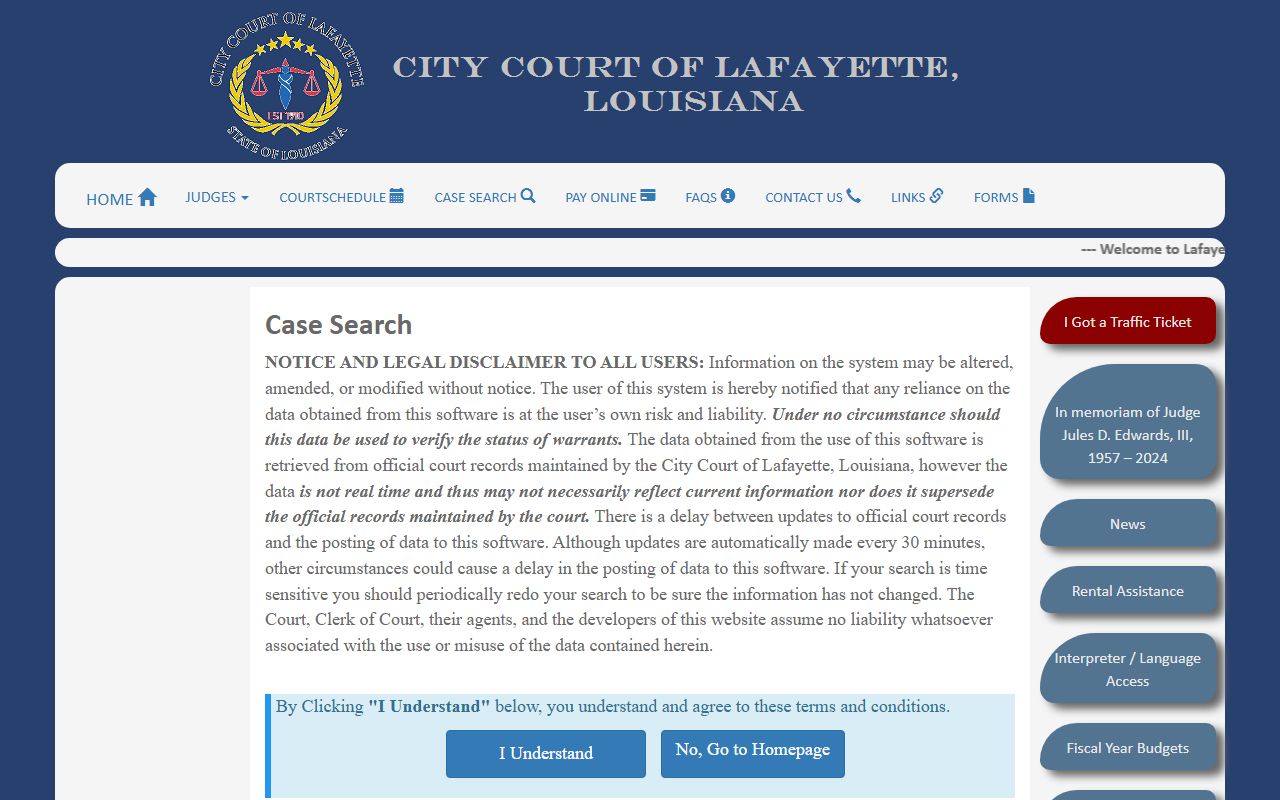
Because the data is not real time, never use it to confirm whether a warrant is active; contact the court for that.
Which Courts Handle Traffic Cases in Lafayette County
Traffic cases split by issuing agency and offense. Lafayette City Court handles many City of Lafayette tickets, including traffic, OWI, and worthless-check division matters. The 15th Judicial District Court and the Clerk handle parish and district-level criminal traffic cases. Mayor's and justice of the peace courts may handle local matters in their areas.
| Court | Traffic Cases Handled | Address |
|---|---|---|
| Lafayette City Court | City traffic, OWI, worthless checks, city misdemeanors | 105 East Convent Street, Lafayette, LA 70501 |
| 15th Judicial District Court | Parish and district-level criminal traffic cases | 800 South Buchanan Street, Lafayette, LA 70501 |
| Mayor's / JP Courts | Local ordinance and limited traffic matters | Municipalities and parish precincts |
Types of Traffic Cases on Record
Traffic records cover a wide range of violations. Some are simple payable tickets. Others require a court appearance or route to criminal court. The list shows common categories.
- Standard moving violations, such as speeding or running a light.
- Mandatory-appearance offenses that cannot be paid online.
- OWI and DWI cases, which route to criminal handling.
- Driving under suspension or without a valid license.
- Hit and run, reckless operation, and crash-related tickets.
Juvenile traffic tickets always require a court appearance and cannot be paid online, regardless of the offense.
What Lafayette County Traffic Court Records Show
A City Court case detail packs in a lot of fields. It covers the defendant, the violation, the disposition, the fine, and any sentence or probation. The table lists representative fields the official interface shows.
| Field | What It Shows |
|---|---|
| Defendant / Name | The cited person and identifying name fields. |
| Case Number / Status | The case identifier and current status. |
| Violation / Amended Violation | The charged offense and any amended charge. |
| Case Disposition | The outcome and whether court was mandatory. |
| Fine Details | Amount to be paid, standard fine cost, and amount paid. |
| Sentence / Probation | Days sentenced, probation length, and court-date events. |
The interface also lists bond amount, dates occurred, and concurrent or consecutive sentence notes where they apply.
Searching by Citation Number vs by Name
The City Court tools let you search different ways depending on the task. The case search uses docket number or name. The online payment page adds a citation-number search. The table shows the main fields.
| Search Field | Type | Required | Notes / Format |
|---|---|---|---|
| Citation Number | Text | Citation search | Required for the payment citation search, with the last name. |
| Docket Number | Text | Docket search | Required for the docket-search mode. |
| Name | Text | Name search | Defendant name for a name-mode search. |
| Last Name | Text | With citation | Must match the offender on a citation search. |
A citation number search is fastest for paying, while a name search helps when you have lost the ticket.
Paying or Contesting a Lafayette County Traffic Ticket
Payable tickets can be handled without court when the offense does not require an appearance. The issuing agency usually submits a ticket within 10 working days, so a new ticket may not be in the system right away. The notice-of-arraignment date is usually 45 to 60 days after issuance, and payment must be made before that date to avoid a court appearance.
- Read the citation and confirm it is a Lafayette City Court ticket.
- Wait up to 10 working days for the ticket to enter the system.
- Check whether the violation is payable online or requires a court appearance.
- To keep a ticket off your record, call 337-291-8736 about driver improvement school before paying.
- Pay at the courthouse, by mail with certified funds, or online by credit card if eligible.
- To contest, respond to the notice and appear in court; do not ignore the date.
Online credit-card payments add a nonrefundable 5% convenience fee, while courthouse credit-card payments add a 3.5% processing fee. No personal or business checks are accepted by mail, and currency should not be mailed.
The City Court pay-online page explains payable tickets, fees, and the plea that payment creates.
The City Court pay-online page lists payment methods, the citation search, and nonpayable offenses.
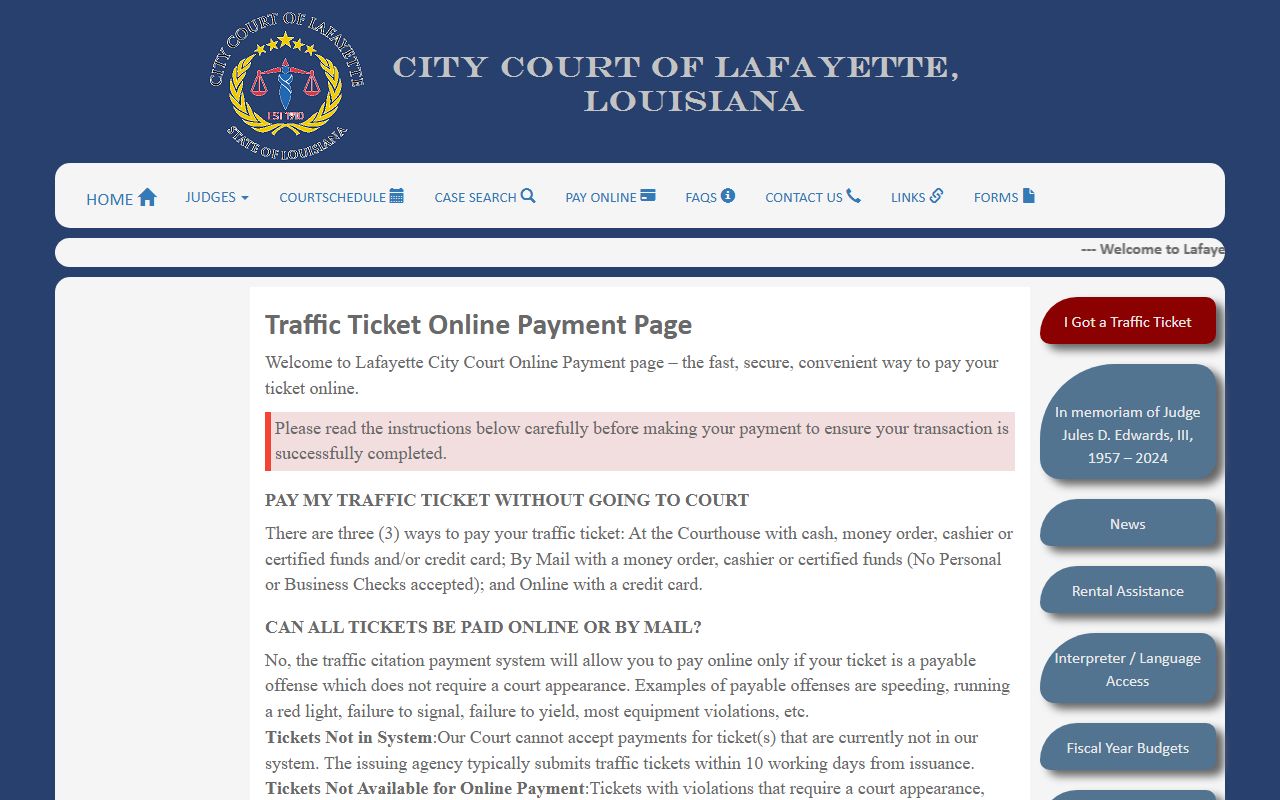
Important: Paying a ticket online is a guilty or no-contest plea, results in a conviction reported to the Office of Motor Vehicles, and waives arraignment, trial, and appeal.
Public Access Laws for Traffic Court Records
Traffic court records are public records under Louisiana law, subject to the same exceptions that apply to other court records. Juvenile traffic matters are restricted, and protected personal data is redacted. The City Court warns that its online data is not the official record and does not supersede the court's official files. So for an official, certified record, request it from the court rather than relying on the online search.
Note: The City Court online data is not real time and must not be used to verify warrant status, so confirm time-sensitive details with the court directly.
Court Traffic Records vs State Driver Records
The court traffic record and the state driver record are two different files held by two different agencies. The court holds the case. The Office of Motor Vehicles holds the driving history. A court conviction is reported to the state, which then updates the driver record. The table compares them.
| Record Type | Source | What It Shows | How to Access |
|---|---|---|---|
| Court traffic record | City Court or 15th JDC / Clerk | Citation, violation, disposition, fine, sentence | City Court search or the Clerk |
| State driver record | Louisiana Office of Motor Vehicles | Reportable convictions, license status, suspensions | The OMV / state driver-record system |
To correct an error, you fix the court record at the court and the driver record at the OMV; they are not the same fix.
CDL and Commercial Driver Records
Commercial drivers face stricter rules. A conviction that a regular driver might shrug off can threaten a commercial license. Many ticket-reduction options that work for ordinary drivers are limited or unavailable for a CDL holder. Because a traffic conviction is reported to the state and can affect a commercial driving record, a CDL holder should think carefully before paying a ticket, since payment is a guilty plea and a conviction.
DUI / DWI Cases
OWI and DWI are not simple traffic tickets. They are criminal matters and cannot be paid online to close the case. These cases route to criminal handling and can carry jail, fines, license action, and a criminal record. For the criminal side, including arrest and case history, see the arrest records page. A person facing an OWI or DWI charge should consider speaking with an attorney.
Deferred Adjudication and Defensive Driving Course
Some drivers can keep a ticket off the driving record by attending a driver improvement school, but eligibility must be confirmed with the courthouse at 337-291-8736 before paying. Removal through that program can happen only once every two years. Because paying a ticket creates a conviction, it is worth checking this option before you pay, not after, since payment locks in the result.
Sealing or Expunging Traffic Records
Some traffic-related records can be expunged under Louisiana's expungement procedures, especially when a charge did not end in conviction or when an eligible misdemeanor qualifies. Expungement limits public access but does not always erase a record for every agency. Eligibility, waiting periods, and fees are set by statute. For the process and forms, the Clerk's expungement guidance and the arrest records page explain more.
Fees for Traffic Record Copies
Copy and certification fees apply to traffic court records, and online payments add a convenience fee. The table shows common figures, with the City Court and Clerk pages holding the current details.
| Item | Amount |
|---|---|
| Online credit-card convenience fee | 5% nonrefundable |
| Courthouse credit-card processing fee | 3.5% |
| Plain copy per page (Clerk) | $1.00 |
| Certified copy (Clerk) | $10.00 plus copy fee |
The City Court FAQ explains the ticket process and the appearance-date rules in plain terms.
The City Court FAQ page covers how a ticket, a notice, and an appearance date work.
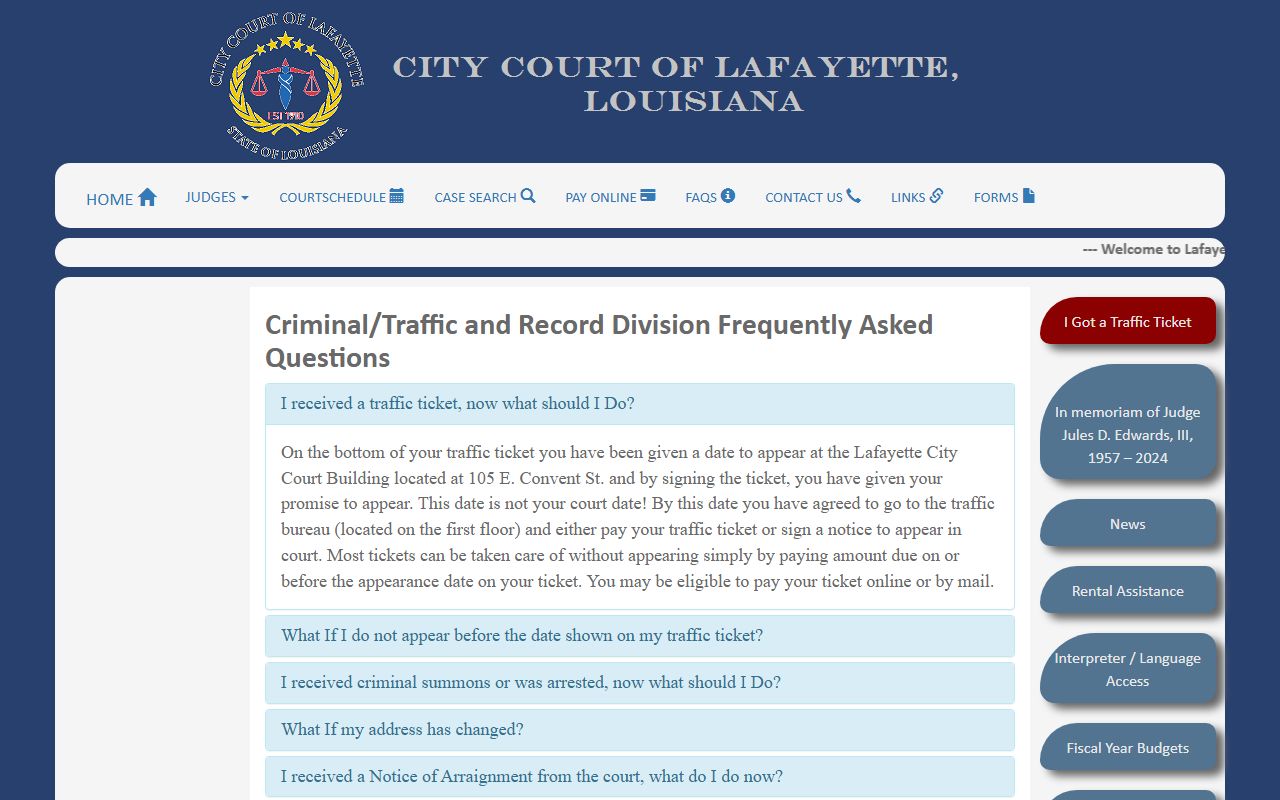
Reading the FAQ first can prevent a missed date that turns a simple ticket into a warrant.